The Story of Pawniard

Along the edge of a forest, the sound of metal scraping against stone echoes.
Near a river, a small red-and-black Pokémon carefully drags the blades along its arms across a familiar rock. Each movement restores the sharp edges that have become worn from previous battles.
This is Pawniard, a Pokémon whose body is covered with blades.
Its arms end in retractable knives, while additional steel blades protrude from its torso and head. These aren't simply weapons Pawniard carries. They're part of its body, essential to both hunting and survival.
Keeping them sharp is a necessity.
According to its Violet Pokédex entry, even a chip in Pawniard's blades could prove fatal. That's why it diligently maintains them after battle, often returning to a favorite sharpening stone near a river.
But Pawniard isn't preparing for battle entirely on its own.
In the wild, Pawniard lives in packs commanded by a larger Pokémon known as Bisharp. When the leader gives an order, Pawniard follows. During hunts, the smaller Pokémon work together to immobilize prey before Bisharp delivers the finishing blow.
Every member has a role within this hierarchy.
And according to Pawniard's Shield Pokédex entry, each Pawniard trains diligently with the dream of eventually taking the lead.
It's an interesting relationship.
Pawniard follows the very Pokémon it hopes to become. It develops its fighting abilities within a structure where strength determines authority, while learning what leadership looks like from the Pokémon commanding it.
For Pawniard, becoming stronger represents an opportunity to move higher within that hierarchy.
But does becoming stronger necessarily prepare someone to lead?
What happens when the qualities that help us earn authority aren't the same qualities we need once we have it?
Pawniard

"They fight at Bisharp's command. They cling to their prey and inflict damage by sinking their blades into it."
—Pokémon White
Pawniard is a remarkably disciplined Pokémon.
Despite its small size, it fearlessly challenges powerful opponents. According to Pokemon Scarlet, "Pawniard will fearlessly challenge even powerful foes. In a pinch, it will cling to opponents and pierce them with the blades all over its body."
Other entries reveal that groups of Pawniard continue attacking even while injured.
This determination is particularly important when considering its place within the pack.
Pawniard isn't the leader. It follows Bisharp's commands, participating in coordinated hunts and performing the tasks necessary for the group to succeed.
Yet its position as a follower doesn't prevent it from aspiring to something greater.
Each Pawniard trains with the hope of eventually leading.
This makes Pawniard an interesting example of ambition developing within an established hierarchy.
It sees the position above it, understands that strength matters within its group, and works toward becoming capable of claiming that position.
We encounter something similar in workplaces, schools, and organizations.
An employee might admire a supervisor who makes important decisions. A student might want to become the captain of a sports team. Someone volunteering for a community organization might eventually hope to coordinate events rather than simply participate in them.
There is nothing inherently wrong with those ambitions.
Leadership can provide opportunities to influence decisions, create change, and help others accomplish things they couldn't easily achieve alone.
But wanting to lead and understanding what leadership requires are two different things.
I remember wondering why my mother never became a supervisor at her job.
She was intelligent, creative, and hardworking. From my perspective, she possessed many qualities that could have made her successful in a leadership position.
At the time, I wondered whether she simply lacked ambition.
As I've grown older, I've considered another possibility.
Perhaps she understood the additional responsibilities, expectations, and pressures that came with supervising her department. Maybe remaining in her existing position was a decision she felt comfortable making.
I don't know whether that was her reasoning. But I've come to understand that choosing not to pursue leadership doesn't necessarily mean someone lacks ambition.
Sometimes people recognize that the position they already have allows them to do the work they enjoy without assuming responsibilities they don't want.
Pawniard's social structure offers an interesting contrast.
Pokémon Shield states, "A pack of these Pokémon forms to serve a Bisharp boss. Each Pawniard trains diligently, dreaming of one day taking the lead."
Human achievement doesn't have to follow that same path.
Someone can become extraordinarily skilled without supervising others. They can contribute meaningfully without holding the highest position. They can instead demonstrate ambition through the quality of their work rather than the authority they possess.
Pawniard reminds us that discipline and ambition can help us grow, but those qualities don't automatically tell us what kind of responsibility we should pursue.
Pawniard used Metal Claw

Pawniard's abilities add another dimension to its development.
Defiant sharply raises its Attack when an opposing Pokémon lowers one of its stats.
Mechanically, an attempt to weaken Pawniard's capabilities can instead make its attacks more powerful.
Emotionally, this represents the determination that emerges when someone feels underestimated.
Imagine an employee being told they aren't ready for additional responsibilities. Rather than abandoning their ambitions, they begin developing the skills they believe will help them earn that opportunity.
The criticism becomes motivation.
But Defiant also introduces a question worth considering. Are we pursuing growth because it matters to us, or because we feel compelled to prove someone else wrong?
Both responses can produce effort, but they don't always lead toward the same goals.
Inner Focus prevents Pawniard from flinching and protects it from the effects of Intimidate.
This is particularly fitting for a Pokémon willing to challenge opponents much larger than itself.
Its determination isn't easily interrupted by an intimidating presence.
Emotionally, Inner Focus could represent someone learning to remain committed to their responsibilities even when others seem more experienced or powerful.
Finally, Pressure causes opposing Pokémon to expend additional PP when using moves.
Rather than simply strengthening Pawniard itself, this ability increases the cost of acting against it.
Together, these abilities reflect different aspects of competition: determination when challenged, composure under intimidation, and the pressure a Pokémon can place on its opponents.
Yet none of these abilities directly teaches Pawniard how to guide another Pokémon.
They help it fight, resist, and persevere.
Those are valuable qualities within its pack, but they don't necessarily prepare it for every responsibility that comes with being in charge.
Pawniard's constant blade maintenance reinforces that distinction.
Its favorite sharpening stone helps keep its weapons effective. It can diligently prepare for the battles ahead, but sharpening a blade doesn't teach it how to coordinate an entire pack.
Still, Pawniard continues training toward the position it dreams of holding.
When it finally evolves into Bisharp, it gains something that personal strength alone could never provide.
Authority over others.
Bisharp

"This pitiless Pokémon commands a group of Pawniard to hound prey into immobility. It then moves in to finish the prey off."
—Pokemon X
Starting at Level 52, Bisharp is no longer simply another member of the pack.
Now it commands one.
During hunts, Bisharp directs Pawniard to attack and immobilize prey before moving in to deliver the finishing blow.
This arrangement gives Bisharp a different relationship with strength.
Pawniard relies heavily on its own blades and fighting abilities. Bisharp can also direct the efforts of other Pokémon.
Its effectiveness now depends partly on how those Pokémon operate together.
But leadership within a Bisharp pack is far from secure.
According to its Black Pokédex entry, "It leads a group of Pawniard. It battles to become the boss, but will be driven from the group if it loses."
Ultra Sun Pokedex entry reveals another limitation. "No matter how strong the Bisharp, it's said that if the blade on its head is chipped, it will retire from its position as the boss."
The very weapon that symbolizes its imposing appearance is also tied to its ability to maintain authority.
Bisharp has gained the position Pawniard once pursued, but that position introduces new pressures.
It must command its followers, compete with rivals, and protect its place within the group.
Pokemon Sword Pokédex entry adds another revealing detail, "It's accompanied by a large retinue of Pawniard. Bisharp keeps a keen eye on its minions, ensuring none of them even think of double-crossing it."
This doesn't tell us exactly what Bisharp thinks or feels. The Pokédex doesn't establish whether it acts from insecurity, instinct, or the demands of its social hierarchy.
What it does reveal is that Bisharp's leadership involves constant supervision and control.
That gives us an opportunity to examine how authority can affect the person holding it.
Bisharp used Fury Cutter

Bisharp's pack operates through a clear hierarchy.
The Pawniard follow orders, while Bisharp directs their actions and completes the hunt.
From a biological standpoint, this coordinated behavior helps the group pursue prey.
In human organizations, structure can serve a similar purpose.
Defined responsibilities, established procedures, and clear expectations allow people to coordinate their efforts without constantly guessing what needs to happen next.
Consider a grocery store.
Cashiers, stockers, department supervisors, and managers all perform different tasks. Their responsibilities overlap, but each position contributes to keeping the store operating.
Without coordination, employees might duplicate tasks, overlook important responsibilities, or struggle to determine who should handle unexpected problems.
Structure helps prevent that confusion.
But structure can also become restrictive when following established procedures becomes more important than accomplishing the purpose those procedures were designed to support.
I experienced this while working for a larger nonprofit.
The organization had established systems and procedures, but I increasingly felt restricted by the bureaucracy surrounding my responsibilities.
I wanted more freedom to enter the community, establish relationships, develop a pipeline of potential clients, and contribute to building something meaningful.
Instead, many aspects of the work felt repetitive and confined by processes I couldn't easily influence.
Eventually, I pursued an opportunity with a smaller nonprofit.
The organizations were approximately the same age, but their sizes and operational structures were different.
I believed the smaller organization would give me more freedom to contribute to its growth.
What I discovered was that freedom without sufficient direction can create problems of its own.
Unlike the larger nonprofit, the smaller organization lacked many of the structures necessary to support its ambitions.
Every day seemed different, but often without a clear reason connected to the mission. Expectations changed, processes were disorganized, and success wasn't consistently defined.
I had escaped the restrictions I disliked, only to encounter an environment where the absence of structure made it difficult to know what was expected.
This is where Bisharp's relationship with its pack becomes especially meaningful.
Bisharp has the authority to direct Pawniard. But its ability to issue commands isn't the same as ensuring those commands create an effective system.
In nature, its established hunting behavior helps explain how the pack functions.
In human leadership, however, we have to consider something more.
Does the structure help people understand their responsibilities?
Does it give them the resources to succeed?
Does it allow enough independence for people to use the skills they bring to the organization?
Too much control can discourage initiative. Too little direction can leave people uncertain about what they're supposed to accomplish.
The challenge isn't simply choosing between freedom and structure.
It's understanding how much of each the situation requires.
Bisharp used Guillotine

Bisharp's position also reveals how fragile authority can become when it depends heavily on displays of strength.
A rival Bisharp can challenge its leadership. Losing can mean expulsion from the pack, while damage to its head blade can end its time as boss.
Even the resources necessary to maintain its weapons are contested.
Bisharp has violent conflicts with Fraxure over locations where sharpening stones can be found.
These stones matter because maintaining sharp blades is essential to the Pawniard evolutionary line.
What once appeared to be a simple maintenance habit in Pawniard now becomes part of a larger struggle for resources.
Bisharp must contend with rivals, external threats, and the demands of the Pokémon it commands.
It faces another threat from Tinkatuff, which attacks Bisharp for its metal.
These relationships demonstrate that gaining authority doesn't remove the challenges surrounding a Pokémon.
It introduces additional ones.
A supervisor might experience something similar after receiving a promotion.
Before becoming a supervisor, their primary responsibility may have been completing their own assignments.
Afterward, they might need to manage schedules, resolve disagreements, train employees, evaluate performance, and answer for results produced by an entire department.
Being excellent at the original job doesn't automatically mean being prepared for those new responsibilities.
This is one reason leadership requires more than ambition.
It requires understanding how individual contributions fit into a larger goal.
Bisharp's hunting behavior provides a useful illustration. Its ability to deliver the finishing blow depends partly on the Pawniard that have already weakened and immobilized its prey.
The leader's success is connected to the efforts of its followers.
Yet Bisharp's constant vigilance against betrayal reveals a hierarchy in which control remains especially important.
It places Bisharp into an interesting dynamic.
Bisharp relies on the pack, but its authority must also be continually defended within that same social structure.
In human organizations, a leader who becomes too focused on protecting their position may overlook the support their team needs to succeed.
A manager might constantly monitor employee productivity without explaining what successful performance looks like. Another might demand better results without addressing obstacles preventing those results.
Authority allows them to issue instructions.
Effective leadership requires understanding whether those instructions actually help accomplish the goal.
But Bisharp's evolutionary journey doesn't end with commanding a single pack.
Among its kind, only exceptional Bisharp can reach a position above the others.
To evolve into Kingambit, a Bisharp must overcome three Bisharp carrying Leader's Crests and then level up.
The path toward its final evolution is directly connected to defeating other recognized leaders.
When that transformation occurs, the scale of its authority changes, but the limitations of leadership don't necessarily disappear just because the number of followers increases.
Kingambit
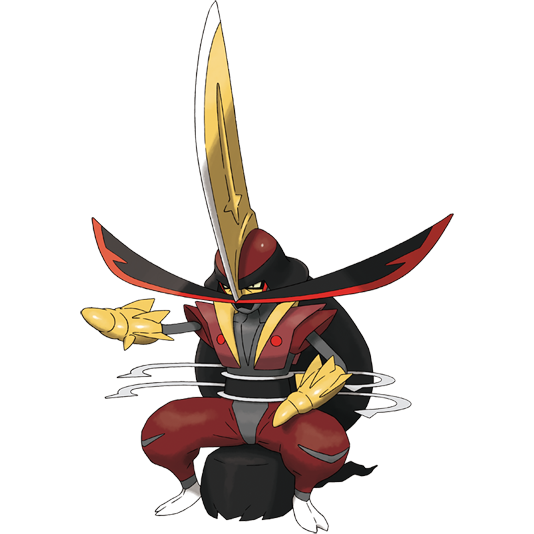
"Though it commands a massive army in battle, it's not skilled at devising complex strategies. It just uses brute strength to keep pushing."
—Pokémon Violet
Where Bisharp commands a pack of Pawniard, Kingambit commands entire groups of Bisharp and Pawniard.
It occupies a position above the leaders that once commanded it.
According to its Scarlet Pokédex entry, "only a Bisharp that stands above all others in its vast army can evolve into Kingambit."
This is the culmination of the ambition first described in Pawniard.
The small Pokémon that once trained diligently under another's command has evolved into a figure capable of commanding a massive army.
By the standards of its social hierarchy, Kingambit has achieved extraordinary success.
But its Violet Pokédex entry reveals something surprising.
"Though it commands a massive army in battle, it's not skilled at devising complex strategies. It just uses brute strength to keep pushing."
Kingambit possesses tremendous power and authority, yet its leadership is not defined by sophisticated planning.
Instead, it relies heavily on overwhelming opponents through sheer force and numbers.
Kingambit has reached the highest position within its evolutionary line but achieving that position hasn't necessarily developed the judgment required to use its power effectively.
Kingambit's approach to battle provides an opportunity to explore one of the most overlooked distinctions in leadership.
There is a difference between being able to command people and knowing how to direct their efforts.
A leader might have dozens of employees, access to substantial resources, and the authority to make important decisions.
But none of those things automatically guarantees an effective strategy.
Imagine a manager who wants their team to increase productivity.
They tell employees to work harder, complete more assignments, and produce better results.
But when employees ask which tasks should take priority, how success will be measured, or what resources are available, the manager cannot provide clear answers.
The manager possesses authority.
What the team lacks is direction.
I encountered a situation like this at the smaller nonprofit.
Part of my work involved going into the community, developing relationships, and building a pipeline of potential clients.
However, we were competing against established programs that already had strong connections and recognition.
Building those relationships took time, and the number of clients I was bringing in wasn't meeting expectations.
My supervisor eventually instructed me to stop working in the field and remain in the office because he believed I wasn't being productive.
The intention was for me to focus on intake and case management.
But without clients being referred to me, much of my work depended on two colleagues bringing people into the program.
Eventually, I was called into a meeting with my supervisor, the chief of staff, and HR.
I was told I wasn't being productive.
When asked what I was doing, I explained that I didn't have enough work because I was relying on my colleagues to bring me clients.
After some discussion, I asked my supervisor a question.
"What are your expectations of me as a Case Manager?"
He paused before responding.
"Well, I want you to case manage."
That exchange stayed with me because I wasn't asking for complete freedom or trying to avoid responsibility. I wanted to understand what successful performance actually looked like.
What was I expected to accomplish?
How would my work be measured?
Yet how was I supposed to meet those expectations when the responsibilities assigned to me depended on factors outside my control?
I had moved from a larger organization where established procedures felt restrictive to a smaller one where unclear expectations made it difficult to succeed.
The problem wasn't simply the size of either organization.
It was whether the structure and leadership supported the work people were being asked to perform.
This is where Kingambit's biology becomes relevant.
Kingambit commands an enormous army, but its reliance on brute strength shows that having more resources doesn't necessarily mean developing a better strategy.
It can continue sending Pokémon into battle, relying on their numbers and strength to overwhelm opposition.
But greater numbers don't automatically solve the limitations of its approach.
Kingambit doesn't teach us that leadership requires less power.
It helps us recognize that power and wisdom aren't interchangeable.
Kingambit's abilities reinforce its relationship with competition and authority.
Like Pawniard, Kingambit can possess Defiant, allowing it to become more offensively powerful when an opposing Pokémon lowers its stats.
It can also possess Pressure, forcing opponents to expend additional resources when using moves.
These abilities reflect qualities already present earlier in its evolutionary line.
But its signature Ability, Supreme Overlord, introduces something different.
Supreme Overlord increases Kingambit's Attack and Special Attack based on how many of its allies have already been defeated in battle.
The more teammates that have fallen, the greater its offensive power becomes when it enters the fight.
Mechanically, this gives Kingambit an advantage after its team has suffered losses.
Emotionally, however, the ability raises an interesting question about leadership.
What does it mean to become stronger because of the people who came before you?
Consider someone who eventually becomes the director of an organization.
Their success may depend on years of work performed by employees, volunteers, donors, and previous leaders.
Perhaps others developed the organization's reputation, established community relationships, or created systems that allowed it to expand.
The director now occupies the highest position, but they didn't build everything alone.
Their authority exists partly because of the contributions of others.
Supreme Overlord doesn't establish that Kingambit consciously honors its fallen teammates or understands their sacrifices. The ability simply converts previous defeats into offensive strength.
But that mechanic gives us a way to examine the responsibility that comes with benefiting from other people's efforts.
A leader might use the contributions of others to strengthen their own position, or they might recognize that their position carries an obligation to support the people whose work makes their success possible.
Kingambit's army demonstrates the power of collective strength, while its limited strategic ability shows that collective strength can still be used ineffectively.
Having many people working beneath you doesn't automatically mean understanding how to help them succeed.
Benefiting from their efforts doesn't necessarily mean recognizing what they need in return.
This creates an important question that Kingambit's evolution leaves unresolved.
If the Pokémon has spent its entire life developing the strength necessary to rise above others, what has it learned about being responsible for those who now follow it?
The Pokédex doesn't give us an answer suggesting that Kingambit becomes a compassionate or strategically gifted ruler.
Instead, its biology reveals the limitations of a system where strength and victory determine advancement.
Perhaps Kingambit's story reveals to us that achieving a goal and developing the wisdom to fulfill its responsibilities aren't necessarily the same accomplishment.
Kingambit used Kowtow Cleave

Pawniard, Bisharp, and Kingambit reveal how ambition, authority, and responsibility can develop along very different paths.
Pawniard begins as a disciplined fighter.
It sharpens its blades, follows orders, and trains diligently with the dream of someday becoming a leader.
Bisharp achieves that position.
It commands Pawniard, coordinates hunts, and competes against rivals to maintain its authority. Yet its leadership exists within a hierarchy where defeat can mean losing everything, and where maintaining control over followers remains an important part of its behavior.
Kingambit advances even further.
It commands entire armies and possesses extraordinary strength, but its reliance on brute force reveals that reaching the highest position hasn't necessarily improved its strategic judgment.
Each evolution brings greater authority.
But greater authority doesn't automatically produce better leadership.
That's an important lesson beyond the Pokémon world.
We often associate promotions, titles, and positions of responsibility with personal growth.
Someone becomes a supervisor, manager, director, or president, and we naturally assume they've developed the skills necessary for that position.
Sometimes they have.
Other times, the qualities that helped them advance aren't the same qualities required to lead effectively.
Pawniard's evolutionary line helps us understand why these distinctions matter.
Together, they remind us that leadership isn't simply the next stage of being good at something.
It's a responsibility that requires its own development.
Perhaps the most important question isn't whether we're capable of reaching the highest position.
It's whether we understand what the people depending on us will need once we get there.
Leadership isn't measured by how many people follow our commands. It's measured by how well we help those people understand their purpose, contribute their strengths, and succeed together.
Choose Your Next Safari Ball Adventure
🎧 Want the human side of Pokémon?
🎙️ As The Pokeball Turns explores the Trainers.
Listen to real stories about:
- Community leaders
- Collectors
- Creators
- Everyday fans

Pokémon GO Wild Area: Finding Joy Between Adventure and Obligation