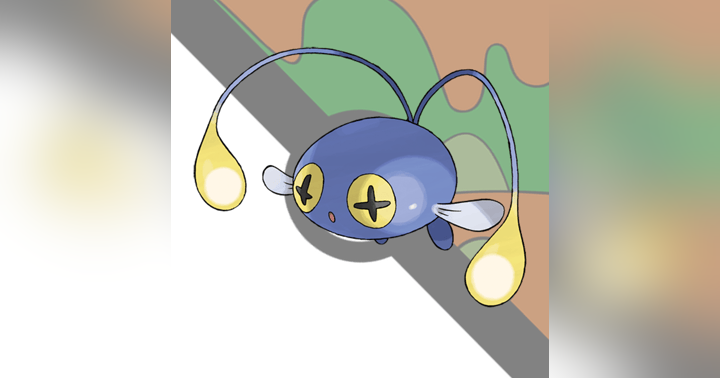
Safari Ball - The Story of Inkay

Welcome to Safari Ball, a field guide series that explores how Pokémon evolve through behavior, emotion, and environment.
Some transformations aren’t sparked by growth. Some require a shift in perspective so drastic, it turns the world on its head. That’s exactly how Inkay, a Psychic and Dark-type Pokémon, begins its most unexpected journey.
In this Safari Ball expedition, we follow the glow of luminescent spots, through dizzying lights and underwater currents, all the way to a Pokémon whose power can rewrite reality itself. But before the control, before the memory loss, before the domination, there’s a flash. A flicker. A clever little creature trying to be seen.
Inkay

"It flashes the light-emitting spots on its body, which drains its opponent's will to fight. It takes the opportunity to scuttle away and hide."
—Pokémon Y
Inkay is a small, squid-like Pokémon that drifts near shallow waters, tidal caves, and echoing shorelines. At first glance, it seems fragile, soft-bodied, slow, and exposed. But Inkay survives not by force, but by understanding attention. The blinking lights on its body are its greatest tool. When danger approaches, Inkay flashes its luminescent spots to overwhelm the senses of its foe. According to Pokémon X, "Opponents who stare at the flashing of the light-emitting spots on its body become dazed and lose their will to fight."
Emotionally, this tells us something important. Inkay doesn’t meet threats head-on. Instead, it creates distance. Its defense is confusion. Not to dominate, but to escape. This is a Pokémon that values safety over victory, choosing retreat when things feel overwhelming. Many of us do this too when we change the subject, crack a joke, go quiet, or step away when emotions feel too intense to face directly.
But Inkay’s lights aren’t only defensive. They’re also a language. In Pokémon Ultra Moon, we learn, "When exchanging information with others of its kind, it flashes the light-emitting spots on its body in a complex rhythm."
Inkay doesn’t speak, it patterns. Its communication relies on timing, brightness, and rhythm, suggesting a deep emotional sensitivity. Instead of words, it uses signals. This mirrors how some people communicate best through actions rather than speech like a text instead of a call, shared music instead of conversation, presence instead of explanation. Inkay teaches us that communication doesn’t have to be loud to be meaningful.
This sensitivity is reinforced by Inkay’s abilities:
Contrary reflects a life lived in reverse where what looks like weakness becomes strength, and what seems like progress can feel destabilizing. Inkay thrives in inversion.
Suction Cups symbolize emotional anchoring. When Inkay chooses to stay, it holds on tightly. It may avoid conflict, but it doesn’t drift aimlessly. It attaches to what feels safe.
Infiltrator suggests a quiet awareness. Inkay can slip past barriers without being noticed, emotionally reading the room before anyone realizes it’s there. This isn’t manipulation yet, it’s observation, learned from needing to survive in unpredictable environments.
Even its evolution reflects this mindset. To evolve Inkay, the world itself must be turned upside down. According to Pokémon Violet, "Being upside-down improves its blood flow and clears its mind, causing the power of its psychic moves to increase dramatically."
This is more than a mechanic, it’s a message. Growth doesn’t come from pushing harder. Sometimes it comes from seeing everything differently. Inkay reminds us that power can be the ability to redirect attention, communicate subtly, or leave before harm arrives and that these, too, are valid forms of strength.
🌑 Curious about survival instincts and emotional complexity?
Explore the Dark-type Personality!
Malamar

"It wields the most compelling hypnotic powers of any Pokémon, and it forces others to do whatever it wants."
—Pokémon X
When Inkay evolves into Malamar, the habits it formed for survival don’t disappear, they intensify.
Malamar doesn’t abandon misdirection; it perfects it. The lights that once confused predators now command obedience. Years of watching, slipping away, and reading others have sharpened into something dangerous: certainty. In Pokémon Violet, it states, "It flashes the luminescent spots on its body to hypnotize its opponents, gaining total control over them."
Behaviorally, Malamar is still shaped by its time as Inkay. It remembers what it felt like to be vulnerable. Instead of fleeing now, it ensures it never has to again. Where Inkay escaped, Malamar controls the outcome.
This is where its abilities take on heavier meaning:
Suction Cups no longer represent safety, they represent refusal to let go.
Infiltrator becomes psychological access, bypassing defenses not to understand, but to dominate.
Contrary remains at its core. A Pokémon whose inner logic is still inverted, still shaped by living upside-down.
This form represents an evolution many face in the real world. After years of defense and misdirection, it becomes easier to control than to connect. Easier to predict others than to risk being known. Malamar is the result of a worldview built on survival. While powerful, it's also increasingly alone.
Its hypnotic abilities are so effective that others seek to use Malamar for unethical purposes. In Pokémon Ultra Sun, we’re told, "When it comes to strong hypnosis, there's an endless number of people who utilize Malamar for their nefarious deeds."
This is perhaps Malamar’s greatest tragedy. Its strengths are admired but not respected. Valued but not protected. When power is built for survival rather than self-understanding, it can be taken, twisted, and misused by others.
Malamar reminds us that skills developed to stay safe can quietly become cages if we never stop to ask why we’re using them.
Mega Malamar

"It uses its colorful lights to overwrite the personalities and memories of others—and to control them."
—Pokémon Legends: Z-A
If Malamar wrestles with the line between manipulation and survival, Mega Malamar crosses it completely.
Through Mega Evolution, Malamar becomes taller, sleeker, and even more intelligent. Its body emits hypnotic colors of greens and pinks that shift with its emotions. And its abilities go beyond hypnosis. According to Pokémon Legends: Z-A, "It uses its colorful lights to overwrite the personalities and memories of others and to control them."
This isn’t just suggestion. It’s identity theft. Mega Malamar doesn’t just bend others to its will. It reshapes who they are.
Its tentacle arms can sense the feelings of those nearby. But instead of empathy, Mega Malamar often uses this information to dominate. It views others as pawns, even its own Trainer, and may hypnotize them if it disagrees with their choices. It fights efficiently, analytically, and with little emotional connection. What began as survival has now become superiority.
Mega Malamar is a chilling reminder that when control becomes our comfort, empathy disappears.
Inkay used Topsy-Turvy

The journey from Inkay to Mega Malamar is one of shifting power, shifting light, and shifting self. Inkay teaches us that survival can look like blinking lights, gentle misdirection, or even retreat. Malamar shows us the cost of clarity without vulnerability and how it can lead to control instead of connection. And Mega Malamar warns us what happens when we let power override empathy, and when manipulation becomes identity.
But at the heart of it all is a message about perspective.
Sometimes, the next step isn’t about getting stronger.
It’s about flipping everything upside down and asking who we want to be when the lights stop flashing.
Choose Your Next Safari Ball Adventure
Solosis | Jynx | Starmie
🎧 Want the human side of Pokémon?
🎙️ As The Pokeball Turns explores the Trainers.
Listen to real stories about:
- Community leaders
- Collectors
- Creators
- Everyday fans
Safari Ball - The Story of Nincada